Many people say that Taiwan’s open source community is very good, especially many experienced experts say so, which made me very tempted. So I decided to take the opportunity of COSCUP 2014 to explore, but I ended up attending for three consecutive years! Many people say that the most beautiful thing in Taiwan is the scenery (the scenery is indeed super beautiful), but after understanding the various aspects of Taiwan’s open source community, as the book says, “The most beautiful scenery in Taiwan is the people.”
However, limited to topics related to open source communities, I hope that whether this article is praise or criticism, please treat it only as the output of the diff command, not as a patch. That is, don’t blindly apply the advantages and practices of Taiwan’s communities mentioned in this article to local communities without thinking or distinguishing. Often this will only backfire. Taiwan’s open source community has achieved its current results precisely because of the humanistic background on this special land.
Preface
Taiwan’s open source community has some advantages over mainland communities, such as more efficient community mobilization capabilities, better community operation levels, and stronger community influence. So what are these advantages, how are they specifically done, what kind of soil has nurtured such community culture, and what are the problems and weaknesses produced by such culture. This article gives my own understanding.
A Large “Banyan Tree” with Luxuriant Branches and Leaves
When I attended Taiwan’s COSCUP 2016 (Taiwan Open Source Conference) for the third time this August, I kept thinking about how to describe the form of Taiwan’s open source community. While thinking, I went to Cheng Kung University in Tainan, originally wanting to find traces of Boeing’s first chief engineer Wang Zhu, but unfortunately the exhibition had been removed. While walking on campus, I came to Cheng Kung University’s famous Banyan Garden. When I saw the large banyan trees with luxuriant branches and leaves, I suddenly became enlightened. Isn’t this form of open source community just like a large “banyan tree”? And everyone is sheltered by the banyan tree!
Diversified Open Source Community Composition—Tree Crown
Many people come into contact with Taiwan’s open source community through individual open source communities, and of course, I am no exception. For example, I started with the Taiwan GNOME User Group, or some cross-strait communities, such as the Fedora Chinese User Group which includes both Simplified Chinese and Traditional Chinese. A slightly deeper level of attention might be attending their local conferences, such as COSCUP (Taiwan Open Source Conference) which I’ve attended three times, or technical seminars like PyCon or HITCON. Actually, if you just look at it from the conference perspective, such conferences are not special. Although the conference provided abundant tea break snacks and lunch (I still drool whenever I think of it), in terms of conference agenda and speakers, there really aren’t many highlights. At the open source community level, the activity format is just offline exchange meetings + social gatherings, and we do the same in Beijing.
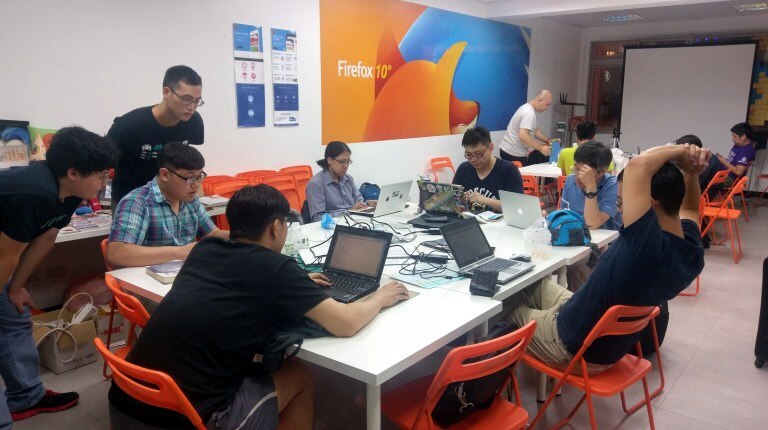
An event held at MozTW
So where are the highlights? Actually, if you think carefully, you can find that this prosperous situation exceeds imagination. Taiwan has a population of 23 million, close to Beijing’s 21.7 million and Shanghai’s 25.17 million, but the number and quality of open source communities far exceed Beijing, which concentrates super-large internet companies like BAT, and Shanghai, which concentrates super-large communication service companies like Huawei. The scale and local influence of annual open source-related conferences also exceed Beijing and Shanghai. I believe the number of technical practitioners in Beijing and Shanghai should be far more than in Taiwan. Whether it’s seminars like COSCUP, HITCON, SITCON (specifically referring to annual conferences here), or various technical communities, these are like the luxuriant tree crown of the banyan tree, only the parts we can intuitively see, so what grew such a “tree crown”?
Deep Cultivation at the Grassroots Level, Promoting Open Source Technology to All People—Branches
When I first attended COSCUP in 2014, I found that many open source technologies are often aimed at ordinary people or meet certain special needs. For example, open source projects providing Accessibility for people with disabilities; or the “anti-wolf map” developed by the women’s open source community WoFOSS, etc. Later this year, I was introduced to visit Tainan’s “PunPlace”, a computer technology promotion caravan for farmers and middle-aged and elderly people; another example is SITCON (Student Computer Annual Conference) promoting the concept of open source contribution to college/high school students through seminars and summer camps; of course, there’s also the Ezgo distribution I’ve been in contact with since 2012, they’ve persisted for many years, always providing GNU/Linux distributions integrating various education-related free open source software for primary and secondary schools; another example is the “Software Freedom Association of the Republic of China”, they successfully promoted the landing of open document format ODF in Taiwan, and now Taiwan government’s internal official documents are starting to switch to ODF-compatible formats.
So many people who deeply cultivate at the grassroots level and don’t often appear in public, their efforts have delivered a large amount of nutrients to the luxuriant “tree crown”—the open source community. Actually, not only those I mentioned, but also many unknown individuals, such as Zeng Zhengjia from the Fedora Chinese community I know, he is constantly promoting free software localization. These “branches” are blocked by the luxuriant “tree crown”, visitors can’t see them, and cameras certainly can’t capture them, but without the support, forking, and delivery of these “branches”, there naturally wouldn’t be such a large tree crown. But how are nutrients and foundations delivered?
Foundations Advocate Symbiosis Values—Tree Trunk
The development of Taiwan’s open source community has some important promoters and supporters. Previously, OpenFoundry (Free Software Foundry) and the Software Freedom Association (and the Ministry of Education Campus Free Software Digital Resource Promotion Service Center it undertook) played a relatively large role as government-guided civil organizations. After OpenFoundry collapsed in early 2015, some civil organizations and people with insight united a batch of civil society groups including g0v (Zero Government), and formed the Open Culture Foundation (OCF) in 2014. This way, after OpenFoundry collapsed, OCF could carry the banner and continue moving forward. Actually, from before to now, regardless of what organization, its purpose is to promote and develop local free open source culture, cultivate and promote the healthy operation of open source projects and communities.
In this sense, various foundation organizations and non-governmental organizations have played a good boosting role in promoting the operation of open source communities. They discover excellent talents, push excellent open source projects to the foreground, support excellent open source communities in place, and make up for the shortcomings of individual development. These foundations or non-governmental organizations are different from the practices of Apache Foundation or Linux Foundation. They pay more attention to cultural construction and the construction of open source atmosphere; not just focusing on open source projects, not just focusing on the commercial value of community products. This is like the thick tree trunk that makes this large banyan tree stand tall, continuously delivering “nutrients” upward. So where do these basic “nutrients” come from?
University/Research Institute Open Source Club Construction—Tree Roots
In the past two years, I’ve been paying close attention to Taiwan’s SITCON (Student Computer Annual Conference) activities and frequently communicating with their personnel. In the various articles I’ve written over the past few years, I’ve praised their achievements, especially the summer camps in recent years which I think are more effective. But before SITCON, many universities/research institutes had established their own free open source software clubs, promoting and developing free software projects in schools. Some research institutes (such as Academia Sinica) even directly produce open source results, including Traditional Chinese input methods used on UNIX systems and GNU/Linux in the early days, and early Chinese translations of some free software. Many excellent open source talents also stand out from universities and research institutes, and more excellent open source talents are being cultivated. Cross-university cooperative club alliances like SITCON make the promotion of open source in universities deeper and more extensive. So as long as such university open source clubs can continue to persist, these grassroots “nutrients” can be continuously discovered and cultivated. This is like the banyan tree’s huge root system, continuously absorbing nutrients from the soil.
Such a large “banyan tree” has open source clubs spread across universities/research institutes as the “root system” to promote, cultivate, and discover talents and projects in universities; has foundations and various non-governmental organizations as the “tree trunk” to promote and support these excellent talents and projects for further development; has various grassroots-oriented open source communities as “branches” to promote the landing application of open source technology; finally, there’s such a luxuriant “tree crown” facing various applications that finally bloom and bear fruit. But what about the “soil” where the banyan tree can grow?
The Soil of the “Banyan Tree”
When I think about the development of Taiwan’s open source community, a voice keeps echoing in my mind. What nurtured this “banyan tree”? Is it feasible to transplant such a “banyan tree” to the mainland? So in these three years, I not only investigated Taiwan’s open source communities and organizations but also spent some time investigating local social life and paying attention to some hot social events.
Collection of Diverse Cultures, Promotion of Multiple Values
Taiwan is composed of multiple ethnic groups in terms of population, not only with a large number of indigenous peoples, but also immigrants from Fujian and Guangdong, immigrants from the Japanese colonial period, and of course mainlanders who fled to Taiwan after the civil war. Culturally, it’s also diverse, with indigenous culture, Hakka culture, Japanese culture, and mainland Central Plains culture (which also includes various characteristic cultures from the mainland). In Taiwan, an important key is that although Han culture is dominant, other diverse cultures have not completely disappeared. Moreover, the modern wave of democratization has made accepting diverse cultures a social consensus, making the promotion of multiple values a common demand from top to bottom in society. While writing this article, it happened that Taiwanese people were gathering to fight for same-sex marriage rights. The power accumulated by diverse cultures and values can provide a foundation for the large-scale influence of open source communities.
Individual Freedom and Social Connectivity
Another thing I feel is beneficial to Taiwan’s open source community is individual freedom. Everyone has the freedom to choose their own path, without patriarchal institutional constraints, and of course, everyone must be responsible for their own choices. This makes accepting free software possible and gives free software promotion a better humanistic foundation. Communities built on this foundation also have stronger mobilization capabilities.
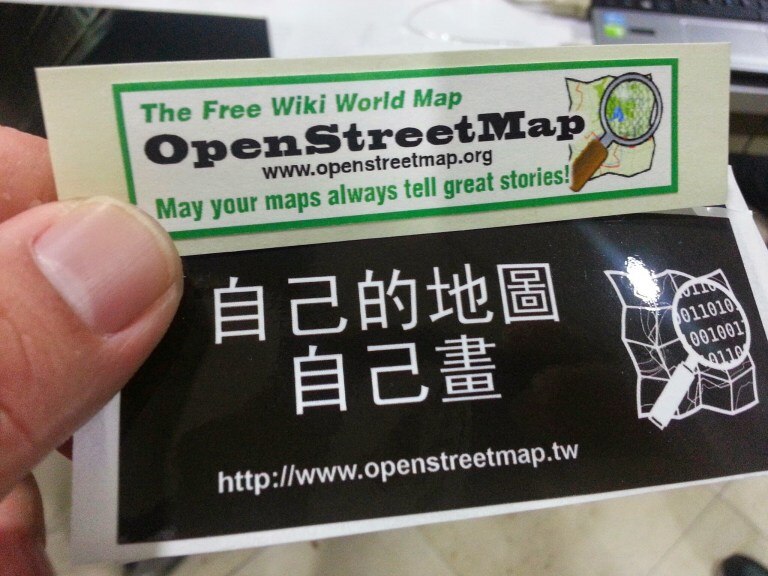
Autonomous consciousness of open source communities
“The World is Public” Ownership Mentality and Decentralized Culture
From another perspective, I really appreciate Taiwanese people’s ownership mentality, although such mentality benefits from multiple political influences such as Taiwan localization movement. Everyone having “the world is public” in their hearts is of course an ideal situation, but in the open source field, many such people are indeed needed. Such ownership mentality provides very convenient application scenarios for the development of open source communities. For example, the Ezgo team and “PunPlace” mentioned above, without the breadth of mind to serve the world and the people, such projects would not have been possible. Similarly, a highlight is Audrey Tang, who used to do free software localization and promotion work, and in October this year became the “Digital Minister” of Taiwan’s Executive Yuan, providing advice for promoting Taiwan’s digital construction.
Taiwan’s education and grassroots social values make everyone unable to become people who only care about their own self-interest. In the high-tech field, there are fewer “refined egoists”, which is a big difference between Taiwan and the mainland, and also an important factor causing open source to be so prosperous in Taiwan.
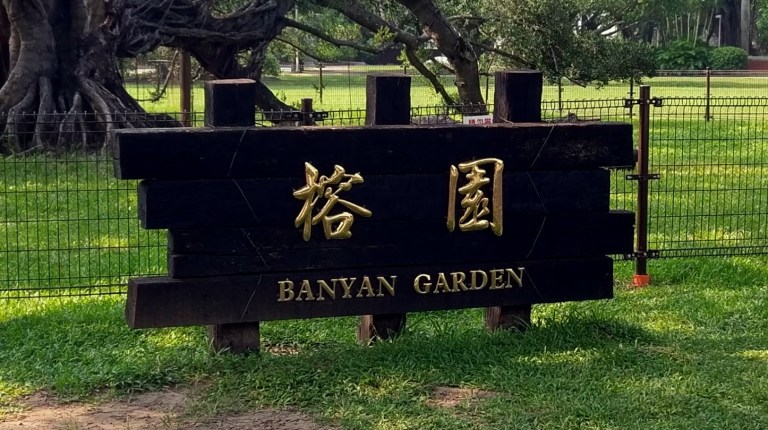
Banyan Garden at Cheng Kung University
Multiple “Banyan Trees” Coexisting in a “Banyan Garden”
If we describe Taiwan’s open source community form as a “banyan tree”, then such a “banyan tree” is not the only one, and this one is not even the largest. There are many similar forms of various social forms, just that I haven’t discovered them. After all, such soil widely affects all levels of Taiwanese society, so multiple “banyan trees” gather to form a “banyan garden”. Various levels promote each other, influence each other, and progress together.
At the same time, I also observed that such soil created such open source community forms and corresponding people, and once leaving such soil, people who could call the wind and rain before would find it difficult to function in other places.
Problems to Avoid
Admittedly, Taiwan’s open source community is doing very well, absolutely rare in Asia, and even unique in the world. But this doesn’t mean they don’t have defects, let alone that some defects are bottlenecks restricting development. This is like a banyan tree—although the tree crown is luxuriant, the tree itself is not very tall.
Populism (Nationalism)
Populism exists in both Taiwan and the mainland. In mainland China, a group of young people represented by “Little Pinks” and “That Rabbit” are carrying the banner of nationalism. There’s no essential difference between the two. In 2015, Taiwan launched crowdfunding for the “Jin Xuan” font, once claiming to be a font for Taiwanese people, and many friends in Taiwan’s open source community contributed to help. But when it was released this year, it encountered various problems, far from public expectations. In mainland China, certain companies vigorously promoted “domestic operating systems”, but when finally released, they were found to be just repackaged shells, criticized by many. These are no different in essence, both consuming local people’s irrational populism or nationalism, and the final results are often all thunder and no rain, or twice the effort for half the result. Such problems are undoubtedly huge obstacles restricting the longer-term development of open source projects.
Disconnection from the International
This year’s COSCUP originally planned to invite the Apache Foundation to speak, even planning a special session, but there were very few respondents. This shows from another aspect that although Taiwan’s open source communities/projects have great local influence, their international influence is very small, and I think the reason for such small influence is caused by too low international participation. In this regard, mainland China, because of the mentality of “worshipping foreign things”, often has strong enthusiasm for participating in large international projects; driven by nationalism, there are also moves to push their own open source projects to large international foundations (such as Apache Foundation), and more large companies spend money to “sponsor” certain open source foundations, even becoming foundation shareholders, intending to control foundations. Just from the Google Summer of Code I’ve been following for the past two years, very few Taiwanese students participate, which doesn’t match Taiwan’s prosperous open source projects/communities. So such disconnection from the international has become a bottleneck restricting Taiwan’s overall open source development, and the future harm is far more than just not coming to COSCUP to speak.
Gap Between Generations
Because Taiwan has a large loss of high-tech talents, the loss of open source talents is also increasing. Many open source communities/projects cannot continue and cannot find more contributors/organizers. Although the same problem exists in mainland China, because the loss of high-tech talents is not as significant as in Taiwan, the impact is not as great. What’s more, new communities are emerging at an accelerating pace, and the gap between generations will always improve. But in Taiwan, this requires organizations like SITCON to exert more effort, and foundations need more driving force.
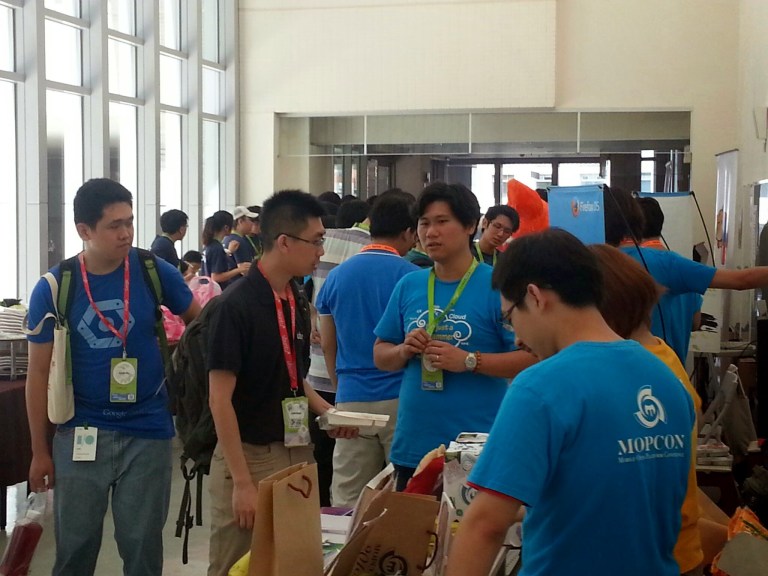
A scene from COSCUP 2014
Commercial Erosion and Influence
The problem of talent loss has a lot to do with commercial fickleness. Before, people doing open source were concentrated in the ivory towers of universities and research institutes, and then appeared at all levels of society, but this also makes them easily eroded by commerce. Especially when people are all rushing about for their livelihood with no time for other things, this situation is even more obvious. On the other hand, a psychological factor produced by local thinking is collective pessimism, which often triggers talent loss. The biggest impact on open source communities is precisely the loss of people, and communities will have to dissolve.
Lessons Learned and Suggestions
As a conclusion, I hope to list here some practices and suggestions that can be learned from Taiwan’s community operations.
Cultivate the Soil
Taiwan’s unique soil can grow “banyan trees” precisely because of various humanistic backgrounds. So how should we do it in mainland China without such soil? Of course, the first is to cultivate soil conducive to open source taking root and sprouting. I think this soil basically has two elements: one is a free environment and free mentality, the other is decentralized community organization. A free environment is not easy to achieve in mainland China, but it should also be vigorously promoted, mainly to promote everyone being responsible for their own affairs and striving for maximum individual freedom.
Take Root at the Grassroots, Start from Details
Many people think that if you’re going to do something, do it big, like an open source foundation. This became a trend of thought in 2014 and 2015, but the results of practice were not ideal, even completely clueless, and such greed for big achievements does no good for open source development in China. I think we should support grassroots community construction more, pay attention to the development of university open source clubs, encourage free open source projects that serve the people, and discover various open source talents. Besides foundations like OCF, Taiwan still has civil non-foundation organizations like the Software Freedom Association, relying on small startups, they are also playing their role.
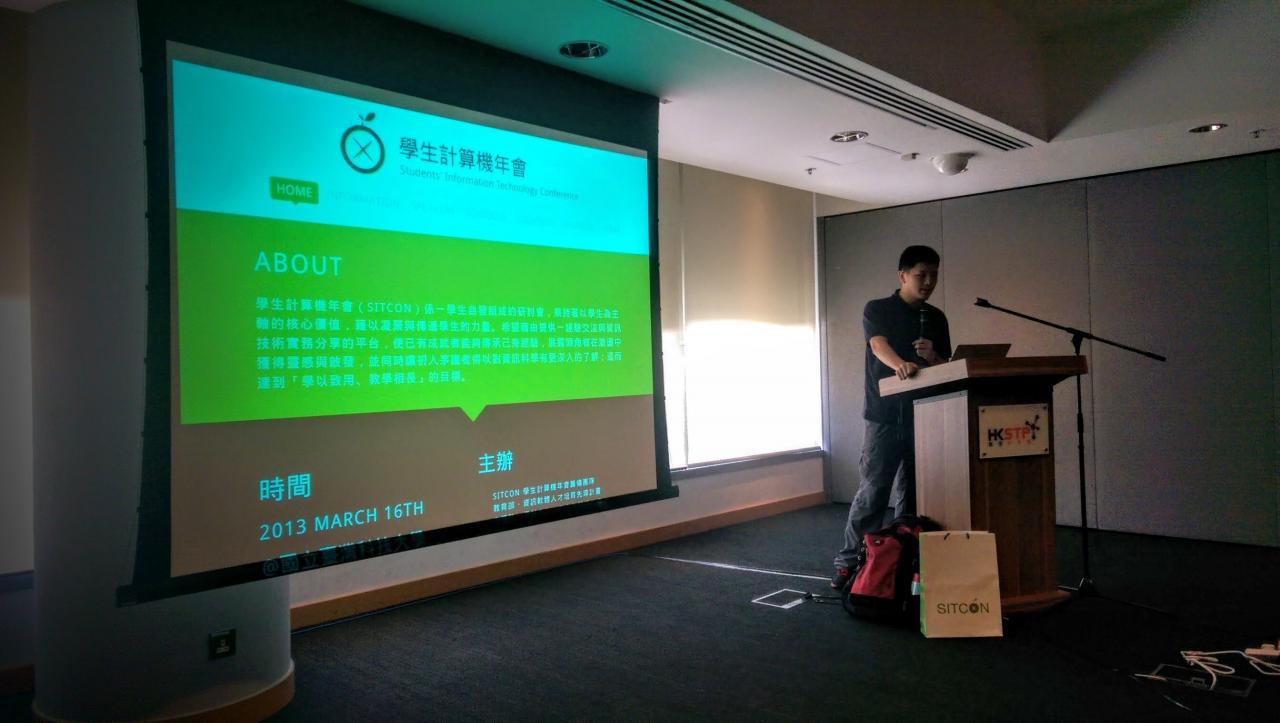
SITCON’s speech at last year’s Hong Kong Open Source Annual Conference, SITCON has now developed to Hong Kong
So take root at the grassroots, spend some time doing community operations well, develop open source projects that truly serve the people, focus on small places, start from bit by bit, persist in doing it, and you will always succeed at the right time.
Self-reliance, Self-governance, Freedom, Self-improvement
On the other hand, education for people is also very important. I’ve been emphasizing people’s self-governance since last year. You can refer to my article “The Way of Free Open Source Community Governance—Inspiration and Reflection from ‘Zhuangzi’ Fables”. Only when open source communities are composed of people who can be self-reliant, self-governing, free, and self-improving can they have a greater promoting effect on open source development.
Promote Community Cooperation, Common Prosperity
One person fighting alone is definitely not enough, and it’s the same in the open source world. Forming communities or even community alliances can produce the greatest combined force. Everyone must think in one direction and work in one direction, all efforts are for common interests, not just for self-interest. This is why I’ve been criticizing domestic foundations for having impure purposes, not only because commercial companies have different agendas and it’s difficult to unify interests, but also because although they’re called foundations, the essence is actually commercial spokesperson institutions, plundering community results for private gain!
What’s ultimately needed is a state of common prosperity in the community, requiring everyone to cooperate and create together. This is not only cooperation between cross-strait open source communities, but also global cooperation. But the premise of all cooperation is self-governance and self-improvement. Without a perfect self, there can’t be strong community organizations.
Finally, thanks to all the Taiwanese friends who gave me a lot of help during these three trips to Taiwan. Thanks to the organizers and volunteers of COSCUP for their hard work over these three years, thanks to MozTW’s Zhao Baiqiang and Irvin Chen for the information provided; special thanks to Professor Ji Zongheng of Tamkang University, teacher Huang Jingqun of Cheng Kung University for the clues provided, and the Ezgo team’s Eric Sun, Cai Kairu, and Franklin Weng for their signed book gifts. They not only took me to visit some famous scenery in Taiwan, but also benefited me greatly.
Reposted from: Developer Relations »