
Over the past two decades, two multi-trillion-dollar enterprise software industries have emerged: SaaS (Software-as-a-Service) software and public cloud. Today, we are in the early stages of the next trillion-dollar software wave—”developer-driven software.” These companies build technologies that make software development and data management processes easier, faster, more secure, and fully democratized.
But before diving into this new software market, let’s look at previous markets and why developer-driven software is emerging.
First, SaaS.
Salesforce went public 16 years ago, and its IPO essentially led the development of the SaaS industry. When Salesforce debuted, its market valuation was just over $1 billion. Fast forward to today: the company’s market valuation hovers around $160 billion, and other SaaS companies (like Shopify, Workday, Docusign, and Veeva) have followed in Salesforce’s footsteps, all with valuations exceeding $30 billion. These companies and other SaaS companies redesigned how companies buy and use software, allowing their customers to pay monthly subscription fees, thereby freeing themselves from expensive software installations, licensing, and endless upgrade cycles. According to the BVP Nasdaq Emerging Cloud Index, the value of emerging public companies providing SaaS solutions has exceeded $1.7 trillion.
While SaaS was emerging, Amazon launched its public cloud service AWS, creating the era of cloud computing. Companies building their own software and SaaS providers flocked to the cloud, massively migrating application workloads to public cloud infrastructure managed by AWS, Microsoft Azure, and Google Cloud Platform.
Over the past 14 years, these three companies’ cumulative annual revenue has exceeded $80 billion, placing Amazon, Microsoft, and Google among the four most valuable companies in the world. The total value of these three public cloud platforms easily exceeds $1 trillion, with no signs of slowing down.
The evolution from SaaS to public cloud has led us to today’s state:
A new trillion-dollar industry is emerging around developer-driven software.
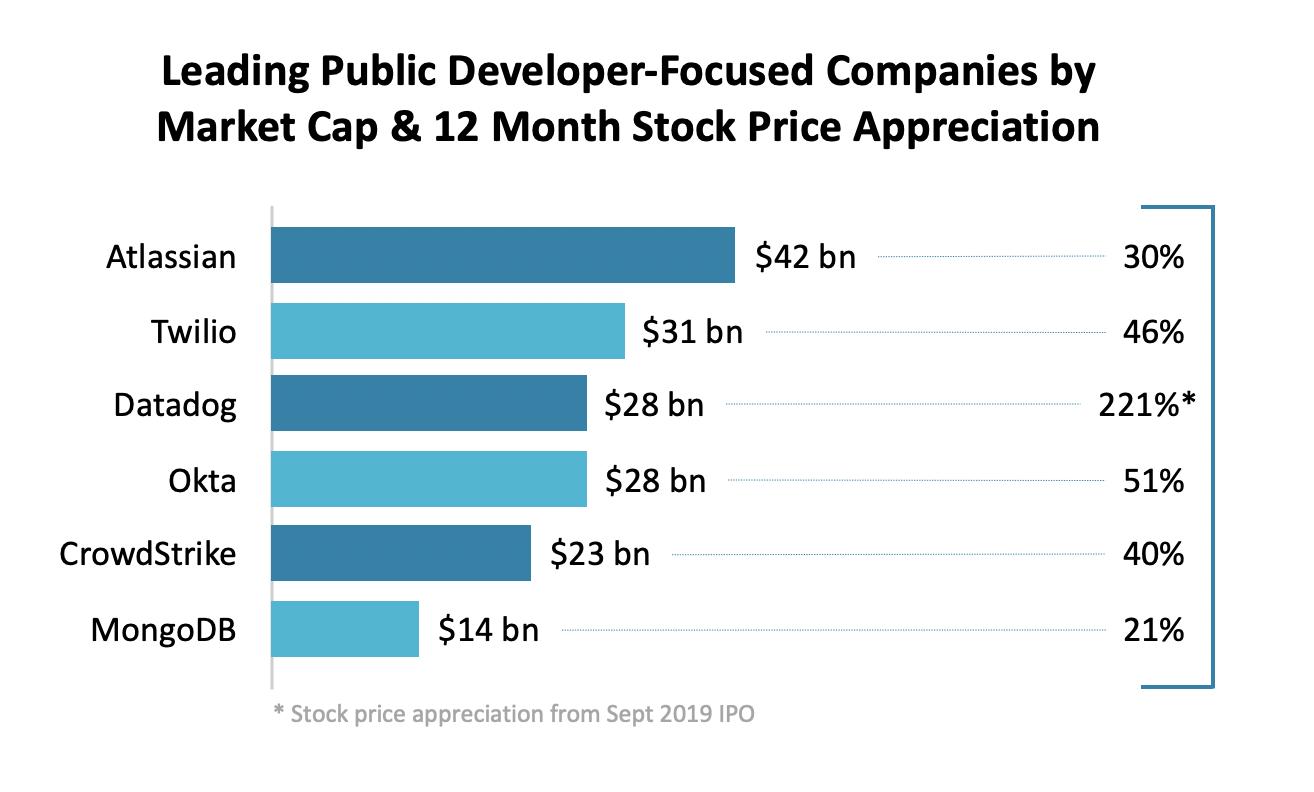
Public software companies with developer-centric focus leading in market cap and stock price appreciation (Source: GGV Capital)
This is the logical next step in enterprise software value creation. A series of developer-driven software companies—from public leaders like Twilio, Atlassian, Datadog, Okta, Crowdstrike, and MongoDB to soon-to-list unicorns including Stripe, Snowflake, and HashiCorp—have market valuations in the billions or tens of billions of dollars.
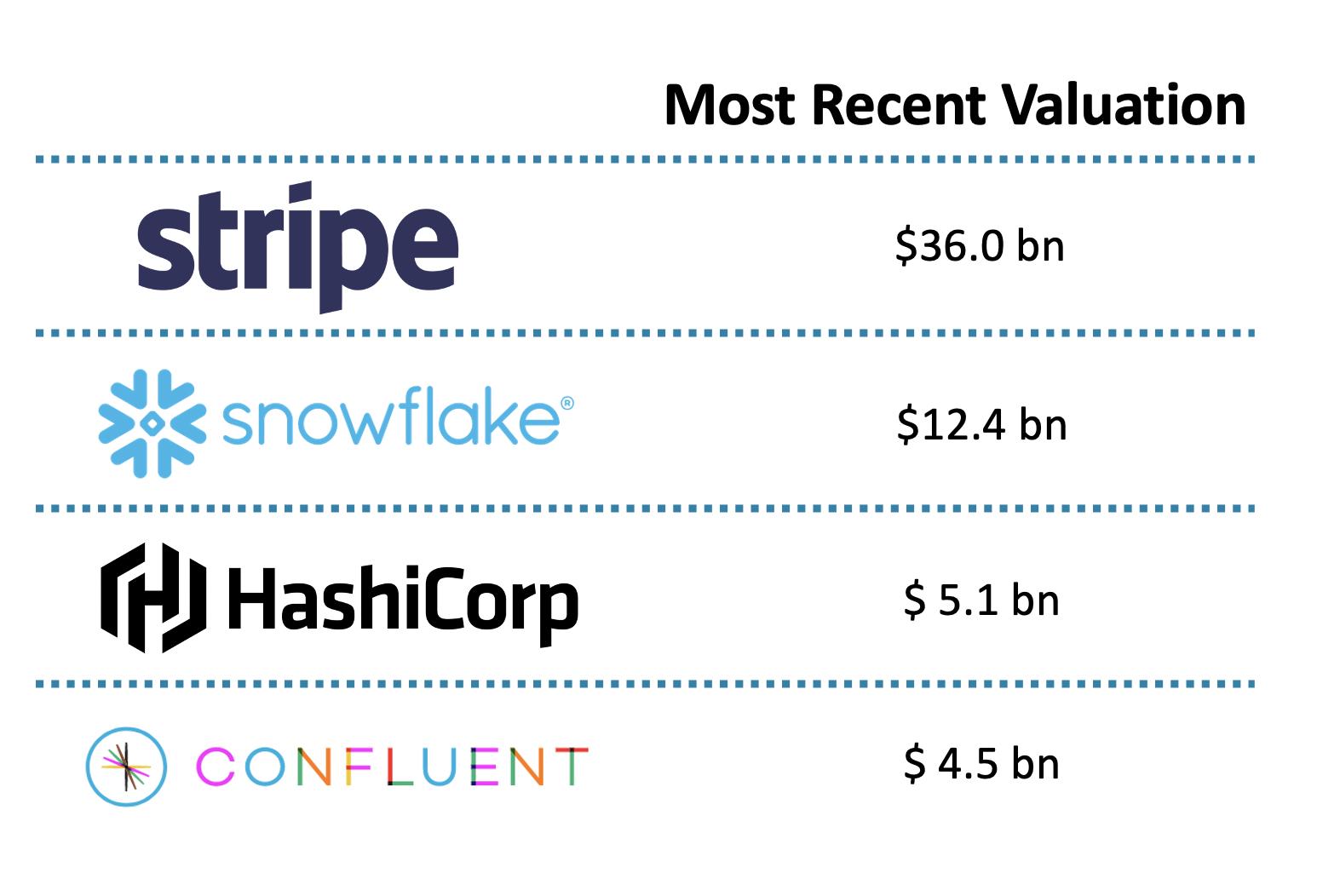
Latest valuations (Source: GGV Capital)
Despite the economic setbacks from the pandemic, this new market continues to gain momentum due to the shift to remote work. Developer software barriers or expensive software licensing fees have caused the traditional development tools market to languish, but these new products are very different. They’re not only easily accessible online but usually free or low-cost, and widely shared in global developer communities. They’re often open source and continuously attract developers to contribute and improve features, usually provided in the form of APIs or SDKs that users can easily use to enhance other applications.
Everything Empowered by Technology
Why is this trend emerging? What does this mean for the entire enterprise software industry? To understand why, think about the last time you ordered Domino’s Pizza. You most likely ordered through a mobile app or online. You could use the interactive pizza builder to make one or two pizzas with your favorite toppings, add some salads, pasta, and drinks, then click buy and wait for the food to arrive at your doorstep. This process is very different from ten years ago, when you had to call your local Domino’s to order by phone. Domino is rapidly becoming a technology company. Ten years ago, the company’s stock price hovered around $12 per share. Today it’s about $380. Domino’s growth rate over ten years isn’t over 30x because people ordered more pizza.
It grew so fast because the company made it easy to order more than just pizza. Since 2010, as Domino transitioned from its initial phone ordering system to an app-based system that entices people to add extra items with just a click or swipe, the average order size has been steadily climbing. Domino’s app also enables personalized ordering, remembering customers’ pizza preferences and offering promotions on their favorite meals. Today, over 70% of Domino’s sales are made through web or mobile. And on the backend, Domino has invested heavily in upgrading its supply chain infrastructure and creating web-based platforms to support franchisees. Who’s supporting all this innovation? Software developers.
Domino isn’t the only company doing this; from Capital One, Tesla, Airbnb to Nike, companies that have grown rapidly over the past decade have one thing in common—they’ve essentially become technology companies.
In every company’s effort to become a technology company, they must create endless software to drive their development. Therefore, it’s no surprise that products enabling developers to build applications quickly, collaboratively, data-driven, and efficiently will become the next multi-trillion-dollar market. These companies will win developers’ favor and create the next trillion-dollar product category in the next decade. As someone who has invested in software companies for over 20 years, I believe this trend will continue. The next trillion-dollar software market will be determined by developers for the products and features they want. It’s software developers who have enabled some of the world’s largest brands to transform into technology companies, so they are today’s kings.
If developers prefer free products, open source tools, and APIs, how will these new enterprise software companies make money? In the next few columns, I’ll dive deep into the emerging business models of this developer-centric, trillion-dollar new software market—the API model, freemium model, and commercial open source model. Clearly, as companies like HashiCorp, Stripe, and Snowflake have demonstrated, these methods can generate huge revenue, but they’re not without complexity. We’ll also evaluate how companies in this emerging trillion-dollar industry can navigate public cloud players before reaching a breaking point to avoid being squeezed, and we’ll examine remote work and how it will accelerate various aspects of the developer-centric software industry.
Original: Why Developers Are Fueling The Next $1 Trillion Software Wave
Author: Glenn Solomon, Managing Partner at GGV Capital
https://mp.weixin.qq.com/s/zvA7ALve6ZfHK1bN_iud2A
Reposted from: Developer Relations »