A Comparative View of Open Source Communities Across the Taiwan Strait
Statement: This article only represents my personal shallow cognitive views, please correct me if there is anything inappropriate! This article compares the similarities and differences between grassroots open source communities on both sides of the Taiwan Strait, and proposes the common challenges and pressures faced by grassroots communities. Perhaps only through deep cooperation between open source communities on both sides can these problems be solved. Originally planned to complete this article in September, but it was delayed until the end of the year due to personal emotional changes, job changes, and family members’ illness and death.
After attending COSCUP in Taiwan in 2014, I wrote an article “A Comparative View of Open Source Cultures Across the Taiwan Strait, which triggered discussions in open source communities on both sides of the strait. It even attracted the attention of Mr. Hao Mingyi, a giant in Taiwan’s publishing industry, who mentioned and quoted it in his new book “If Taiwan is Surrounded by Ocean” published in September this year. At the same time, Mr. Hao also personally attended this year’s COSCUP 2015. A year later, when I look back at this article, I can’t help but feel that it is still somewhat one-sided, lacking practical investigation and sufficient understanding, and there are still many places that need to be supplemented.
From 2014 to 2015, through various platforms, I kept in touch with the grassroots open source community on the other side, continuously investigating and comparing the differences between open source communities on both sides. During my participation in COSCUP 2015 this year, I tried to make up for the missing parts, especially deepening contact and communication with friends who couldn’t communicate deeply last year, and chatted with some “COSCUP-Haters” to hear their views. This year, I not only talked with young people, but also communicated with older people and personnel from traditional large companies to get more views between “generations”. Unlike last year’s praise for the Taiwan open source community after attending COSCUP, this year I have more rationality and open-mindedness. Perhaps it is also related to the changes in my own mental views over the past year.
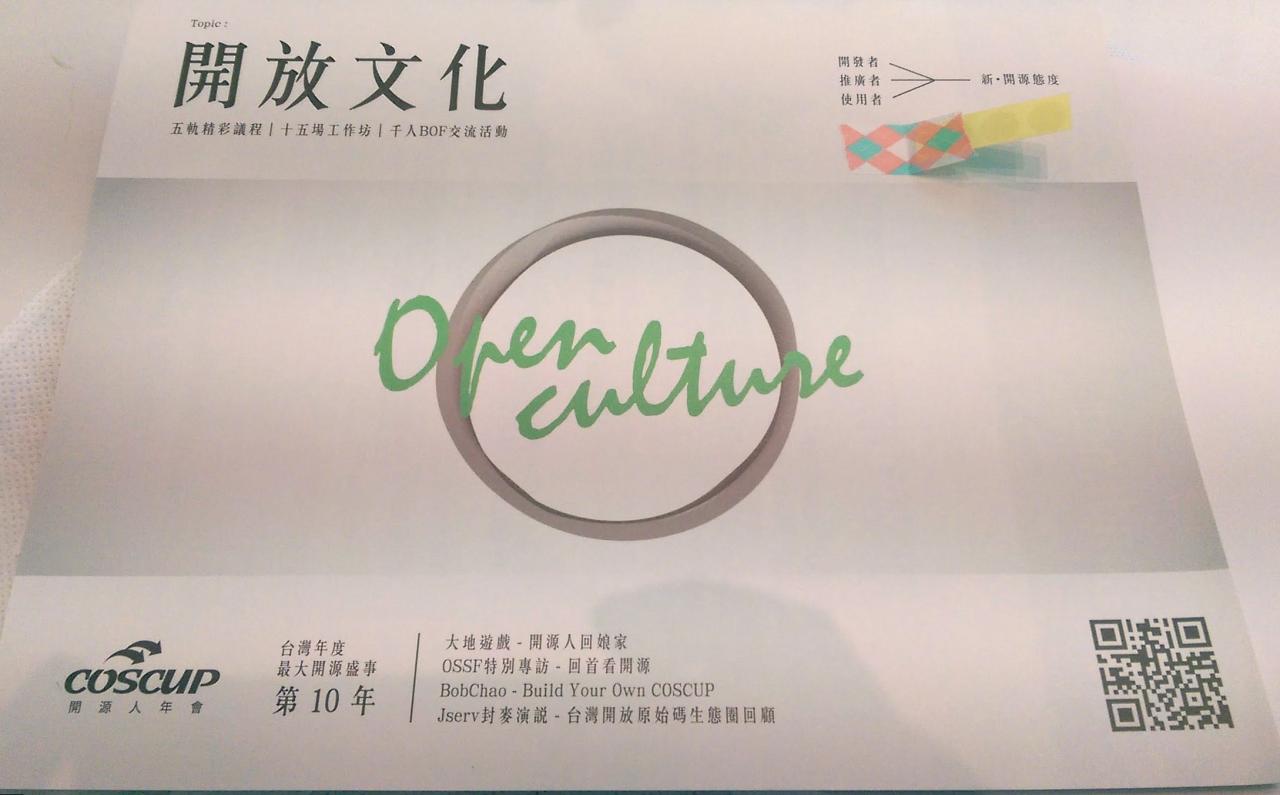
The theme of COSCUP 2015 is “Open Culture”
In recent years, I have focused more on decentralized and grassroots community governance, so this trip to Taiwan only focused on grassroots communities, no longer considering other organizational forms at all. I decided to write another article “A Comparative View of Open Source Communities Across the Taiwan Strait” based on last year’s article “A Comparative View of Open Source Cultures Across the Taiwan Strait.
Scattered Soldiers vs. Autonomous Co-prosperity
It is difficult for grassroots open source communities in mainland China to form scale and community advantages. Even the Beijing Linux User Group (BLUG) that I participate in cannot play community advantages well, which is closely related to the casual style of community members and the overall free-oriented style of the community. However, more grassroots communities are too casual to organize effective development or new activities, so they cannot produce any new value, and many once active communities exist in name only. The reason for this problem is that community members lack personal autonomy, always hope that others will help, and do not realize that they should take action to govern their own communities.
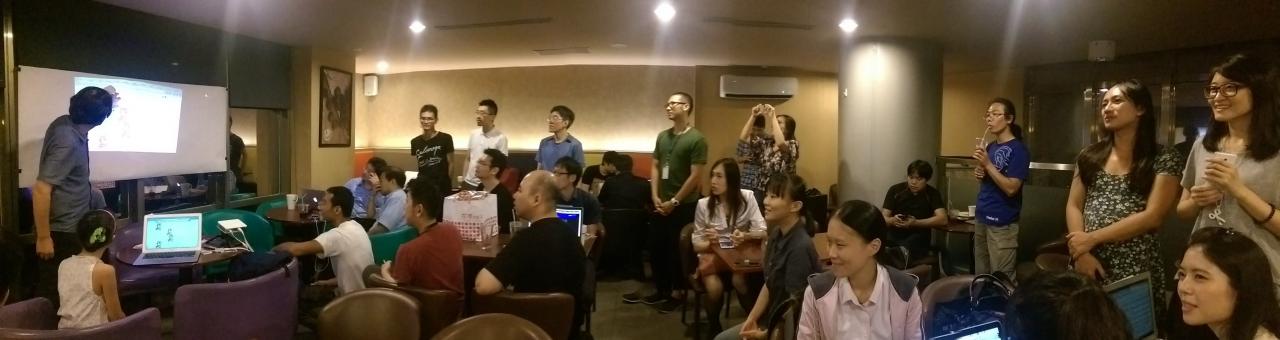
Participating in activities jointly organized by Hacking Thursday and WoFOSS
Relatively speaking, the autonomy of Taiwan’s open source community is very strong, and the autonomy and self-responsibility awareness of members are stronger than those in mainland China. During this trip to Taiwan, I happened to meet two communities, Hacking Thursday and WoFOSS, jointly organizing activities. During the activities, I communicated with many new friends and found that members of Taiwan’s open source community have a relatively strong sense of autonomy, and the community’s self-governance ability is relatively strong. That is, compared to mainland open source communities, Taiwan’s open source communities are more mature and have more of their own value, so they can have stable community cultural output and more stable community influence. This point will be mentioned many times in this article below.
Business-Oriented vs. Community-Led
From the perspective of results, over the years, mainland China has almost no internationally famous or groundbreaking open source projects. Maybe Alibaba’s Tengine is relatively internationally famous, but it is not an open source project initiated or maintained by a grassroots community. The OSChina website has collected more than 5,800 domestic open source software. Let’s see which ones are internationally famous or have international groundbreaking, and which ones are truly maintained or led by grassroots communities. My meaning is not that there are no internationally famous ones in mainland China, like fcitx input method framework, WenQuanYi fonts, etc., but there are far fewer truly groundbreaking and globally universally applied ones. Even if there are, they are often not maintained and inherited by grassroots communities.
Since there are no international open source projects of our own, let’s squeeze into our position in existing international projects. Taking advantage of nationalism and the government’s “independent and controllable” idea, for example, a certain super large company in China (its name cannot be said) encourages its employees to contribute to international mainstream open source projects, or poaches people from members of open source foundations, such as Linux Foundation, Docker Foundation, OpenStack Foundation, Linaro Foundation, etc. While contributing, this large company uses its strong financial and personnel advantages to gain enough voice from these foundations, and even influence these foundations to serve its own purposes, ultimately serving its commercial purposes, and even endorsing nationalism and the government’s “independent and controllable”!
One of the gains in Taiwan this time was listening to the closing speech by Jim Huang (黄敬群,Jserv), the author of the LXDE desktop environment and a major contributor to the Android project. In his speech, he reviewed Taiwan’s open source journey over the past decade, including several famous open source projects, which let me know that besides LXDE and PCManX, there are so many internationally famous open source projects, such as CLE (Chinese Linux desktop), Open Webmail, Firefox OS (led by Taiwan), MCLinker (LLVM linker), uming/ukai free fonts… and these have almost no leadership or influence from large companies.
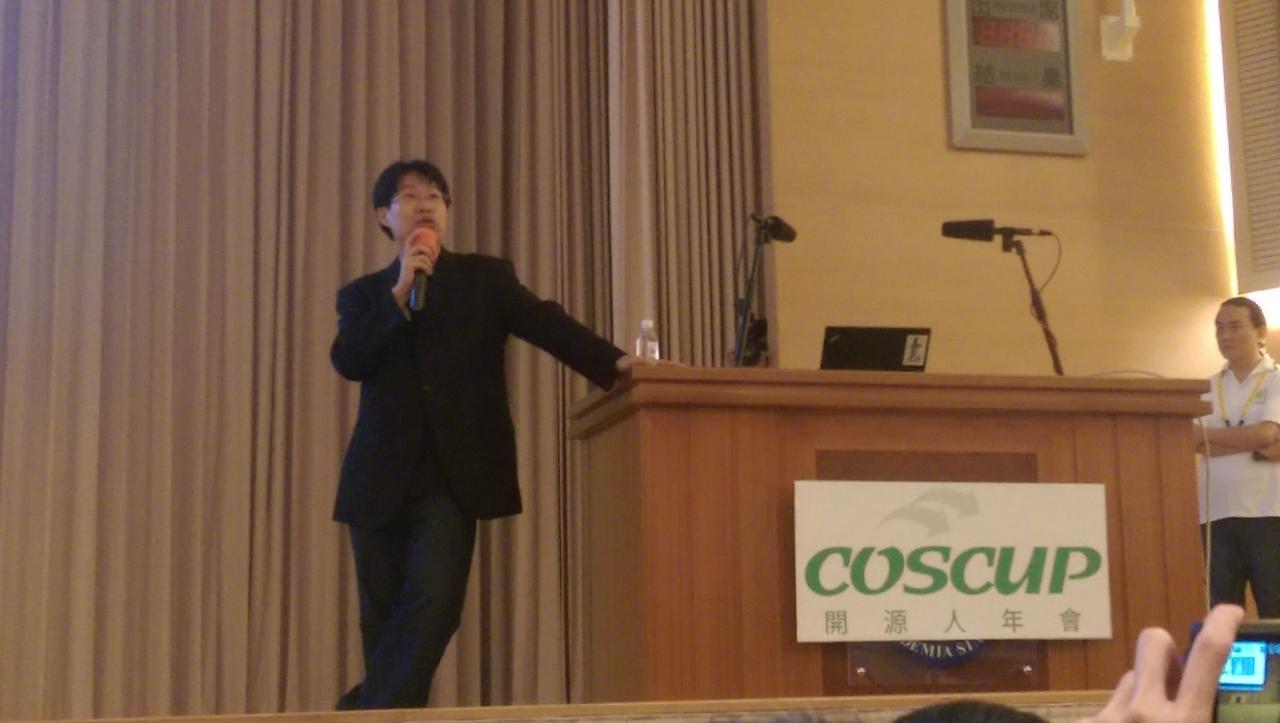
Jim Huang’s closing speech at COSCUP 2015
Grassroots communities develop open source projects based on interest, which are not absent in mainland China, but they often die before they become climate, or are pocketed by large companies, or closed to start their own businesses, reduced to cannon fodder in commercial wars. In the commercial tide, we need to emerge more open source projects maintained by grassroots communities, which requires joint efforts and changes from community governance to project management.
School Leadership vs. Student Autonomy
An important component and talent source of grassroots communities is student associations. Since I learned about Taiwan’s SITCON (Student Computer Annual Conference) at COSCUP last year, I have been paying attention to the development of this organization and its activity methods. I also watched the online live broadcast of SITCON 2015. In addition to holding conferences, it has also launched summer camps, community discussions and other activities in the past two years. In my opinion, cross-school large-scale association alliance organizations like SITCON have very strong vitality and community influence. At this year’s COSCUP 2015, many student volunteers and speakers are members of SITCON. They have made great efforts in spreading open source concepts, conveying the spirit of contribution and participation awareness.
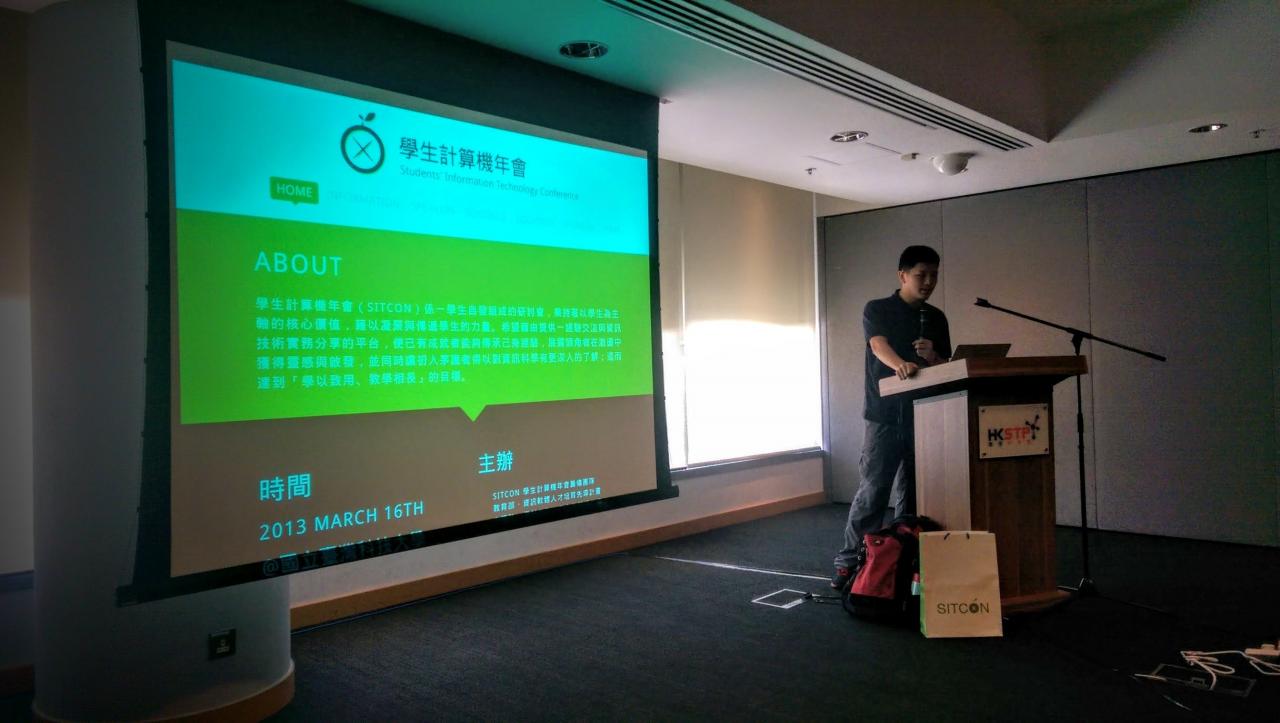
SITCON’s speech at this year’s Hong Kong Open Source Conference, SITCON has now expanded to Hong Kong
There is no cross-school association alliance organization in mainland China, and even if there is, it will be banned or taken over by party groups and strongly controlled. Many colleges and universities have their own open source associations, Linux associations and other organizations, most of which are under the strong control of the school party committee, youth league committee and other leaders, their activity freedom is greatly affected, and it is impossible to have any community influence, making it difficult to attract the attention of student groups in the school. Some association organizations have become entrepreneurship promotion associations under the influence of the school, completely moving towards profit-seeking. However, there are also some association organizations that survive in the cracks. They do their best to innovate activity forms, introduce open source projects suitable for students, and guide students into the ranks of open source contributions. Among them, the outstanding ones are USTC LUG of University of Science and Technology of China and TUNA Association of Tsinghua University.
According to my observations a few years ago, I found that student groups in associations generally lack autonomy, self-discipline and self-responsibility, which is particularly obvious in second-tier and third-tier undergraduate schools. The company I worked for last year used this feature of students, targeting students in worse schools, eager to catch up and worried about employment, to instill in student groups the idea that “open source is free sharing” and “open source contribution = a stepping stone to big companies”. Although this approach cannot be considered wrong, making student groups so “profit-driven” is very detrimental to the improvement of students’ autonomy, and even more detrimental to the construction and development of grassroots open source communities.
Challenges of Grassroots Open Source Communities
Whether in mainland China or Taiwan, the challenges faced by grassroots open source communities have emerged and are becoming increasingly severe. Each of these challenges affects the survival and development of communities. The following are my views on the community challenges I have observed.
Intergenerational Inheritance Gap
Many open source communities face such a problem, worrying about the “successor” problem. Many communities die slowly because no one inherits them. The current situation is that new community members have not yet become climate, and old community members leave (due to career changes, personal reasons, etc.). Even in Beijing, like BLUG, which has established intergenerational inheritance very early, it still faces the problem of intergenerational gap, with deep worries. When participating in the activities of Taiwan TOSSUG (Taipei Open Source Software User Group) this time, I found that they also worry about this problem. Many times, they find that the open source contributors or those who participate in offline activities are the same people, and few new faces are seen.
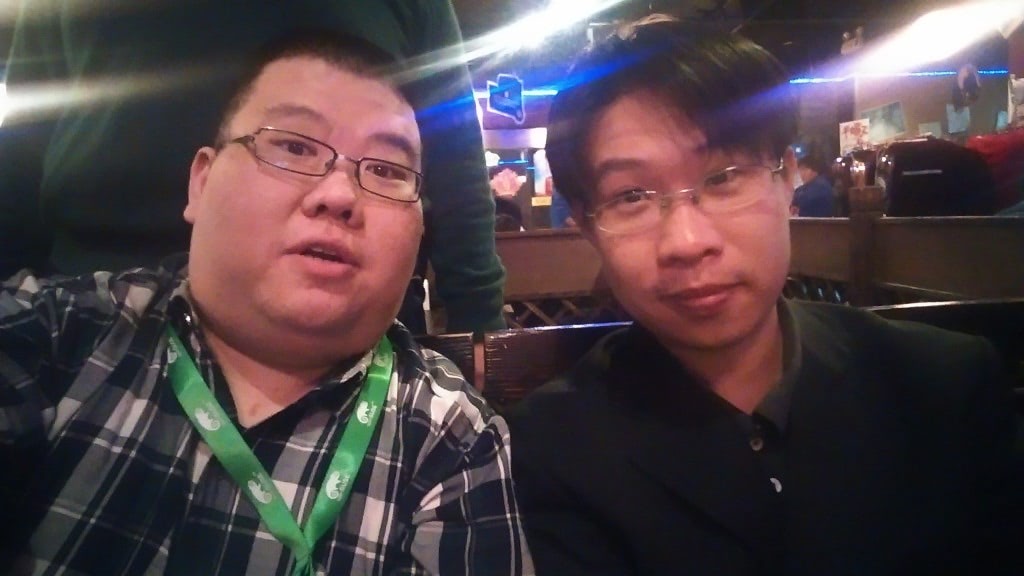
Jim Huang (right) and me
How to solve it? In November, Jim Huang came to Beijing to participate in activities and gather with BLUG. He pointed out sharply that “open source communities need to be more ‘open source’” (widen the source), need more inclusiveness from communities, need to expand more channels, and also need to actively cultivate the growth of newcomers (this is exactly what Jim Huang is doing in Taiwan now). The living space and channels of grassroots open source communities in mainland China are very narrow, which limits their development ability. Coupled with limited community ability, the development dilemma is very serious. I will still make more attempts in BLUG, explore new models of community governance, and strive to open up more channels and living space.
Centralization Pressure and Temptation
Another challenge is that large companies hope to “co-opt” open source communities after seeing their value. Some people will say, wouldn’t this be good? But this will sacrifice the independence and non-profit nature of the community, and further weaken the autonomy. For people who lack autonomy, the temptation of large companies is very strong. Jim Huang bluntly said in his closing speech at COSCUP this year: “You could have changed it yourself, don’t degenerate into a ‘sedan bearer’ for some commercial companies”. For example, a certain Linux distribution in China finally started a business and entered the government’s popular industry “domestic operating system”, and even endorsed the nationalism of “independent and controllable”, which is really sigh-worthy.
I personally value community autonomy and independence very much, which can be referred to the article I wrote in May this year “What do open source communities need most?”.
Economic Value Transformation
Facing challenges, there are also opportunities. Although grassroots open source communities despise economic interests, if they can have good products, it will obviously be of great help to their own development. This year, the Taiwan Ezgo team took me to visit Mr. Hong Zongsheng, the designer of Banana Pi, and also visited his studio. Banana Pi is a product completed by Mr. Hong Zongsheng and the open source hardware community in Shenzhen, which is very successful and has great influence. Currently, many chip manufacturers hope to cooperate with him.
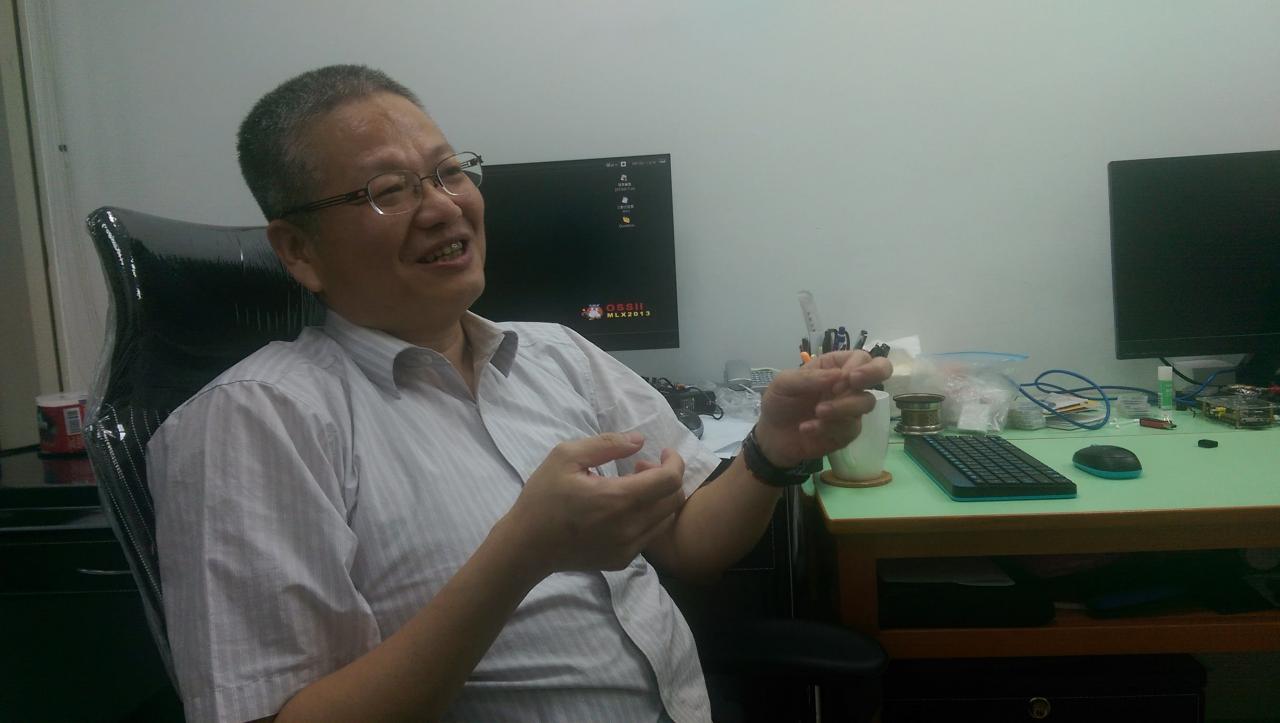
Mr. Hong Zongsheng, the designer of Banana Pi
Similarly, there is the “CPR Circuit Team” born from COSCUP, which successfully started a business to undertake professional wiring and network setup services for conferences.
The success of “Circuit Team” and Banana Pi is not an isolated phenomenon. Behind this is both the success of community governance and the ability to keenly capture market needs. The most important thing is still the down-to-earth, self-innovative practical spirit. We don’t need communities that eat and drink every day, gather to talk nonsense and brag. We need grassroots community organizations that can create communication and cooperation opportunities (such as SITCON and Hacking Thrusday), or have specific results (such as “Circuit Team” and Banana Pi), or can lead and maintain internationally influential open source projects (such as LXDE).
Cross-Strait Open Source Community Cooperation
At the end of my article “A Comparative View of Open Source Cultures Across the Taiwan Strait, I asked “What is separated by a shallow strait?”, calling on mainland China to promote social and cultural progress through the development of open source communities. A year has passed, but grassroots open source communities have not developed, but have regressed by leaps and bounds. Autonomy has not improved at all, open source communities have fallen one by one, or thrown themselves into the arms of large companies and the government!
The grassroots open source communities in mainland China and Taiwan face similar challenges. Taiwan may find it easier to solve problems and simpler to govern communities because members have relatively higher autonomy and the social environment is freer (mainly the Internet); while the advantage of mainland China is that there are more opportunities, capital is relatively concentrated, and it is suitable for entrepreneurial development. In this case, grassroots open source communities in mainland China and Taiwan can completely cooperate, jointly establish cross-strait open source communities, and promote the two-way implementation of open source between the two sides. I believe that grassroots open source communities, that is, decentralized community cooperation, are easier than other aspects of cooperation, because young people have similar or the same culture, have a wide recognition of decentralized community governance, and have more consensus on the true open source spirit (hacker ethics) - this is a real consensus, not “no consensus, forced to say consensus”.

Mr. Hao Mingyi’s gift book
I hope that cross-strait open source community cooperation can follow the principles of “free autonomy, mutual respect, grassroots integration, and connected prosperity”. Each community should understand that “their own community is governed by themselves”; every member of the community should also be self-responsible and effectively take responsibility for the development of their own community. At the same time, communities and communities, people and people should also respect each other’s community characteristics and respect each other’s chosen community development routes (such as entrepreneurship or shutdown). At the same time, what I hope for is integration and cooperation between grassroots, not involving enterprise commercial company communities, or even government departments; only between grassroots communities is it possible to have more consensus on the true open source spirit (that is, hacker ethics), and it is possible to deeply integrate and connect. Finally, achieve the common prosperity of open source communities on both sides of the strait. Why I propose these sixteen-character principles is also related to my views on open source community governance over the past year. I believe that only autonomy can lead to co-governance, only selfishness can lead to selflessness, and only freedom can lead to co-prosperity. Mr. Hao Mingyi said in his book “If Taiwan is Surrounded by Ocean” that “dare to cooperate with the other side”, this sentence is not only said to Taiwanese, but also to mainlanders. Cooperation can create value, and working behind closed doors will eventually destroy oneself. What’s more, the essence of the open source spirit is to create greater value by promoting connections between people.
2015 is the tenth year of COSCUP. Over the past ten years, COSCUP has made indelible contributions to the promotion of open source and open source development in Taiwan, promoting connections between people, and cooperation between communities. Looking forward to COSCUP 2016, the upcoming 2016 will open the “post-ten-year era” of COSCUP. Here I dare to make an immature suggestion: why not set the theme of COSCUP 2016 as “Cross-Strait Open Source Community Cooperation”. I sincerely hope that open source communities on both sides of the strait can deepen cooperation, exchange needed goods, and integrate with each other, making 2016 the first year of cross-strait open source community cooperation.
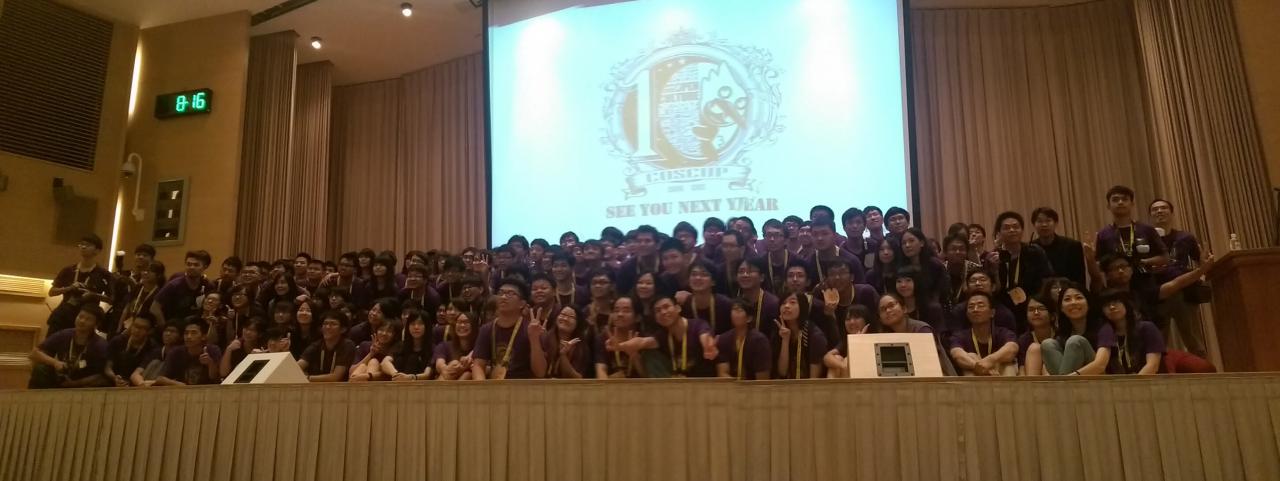
Thank you to more than 200 volunteers for their contributions and efforts, making this year’s COSCUP so successful
Author: Love Open Source Phantom Original: A Comparative View of Open Source Communities Across the Taiwan Strait
Reprinted with permission: Developer Relations »