GNU, Open Source, and Apple's Dark History
The debate between the free software/open source community and Apple can be traced back to the 1980s, when the founder of Linux called the core of Mac OS X “a piece of garbage”. There are also some other anecdotes in software history.
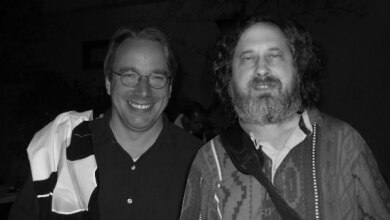
Open source advocates have a long and fluctuating relationship with Microsoft. Everyone knows this. However, in many ways, the dispute between free or open source software supporters and Apple is more prominent—although this rarely receives media attention.
It should be noted that not all open source advocates hate Apple. From various anecdotes, I have seen many Linux hackers playing with iPhones and iPads. In fact, many Linux users like Apple’s OS X system so much that they create many Linux distributions designed to look like OS X. (By the way, the North Korean government did this.)
But the relationship between Mac believers and penguin believers—that is, the Linux community (not including others, just this small part of the free and open source software world)—has not always been completely harmonious. And this is by no means a new phenomenon, as I discovered when researching the history of Linux and the Free Software Foundation.
GNU vs. Apple
This war will go back to at least the late 1980s. In June 1988, Richard Stallman launched the GNU project, hoping to build a completely free Unix-like operating system whose source code would be freely shared, strongly criticizing Apple’s lawsuit against Hewlett-Packard (HPQ) and Microsoft (MSFT), saying that Apple’s claim that others copied the Macintosh operating system’s interface and experience was incorrect. If Apple became popular, GNU warned, the company “would use its new popular power to end free software that was born to replace commercial software.”
At that time, GNU was fighting Apple’s lawsuit (which means, ironically, that GNU was supporting Microsoft, although the situation was different at that time), by releasing “Keep your lawyers away from my computer” buttons. At the same time, it called on GNU supporters to boycott Apple, warning that although the Macintosh looked like a good computer, if Apple won the lawsuit, it would bring a monopoly to the market, which would greatly increase the price of computers.
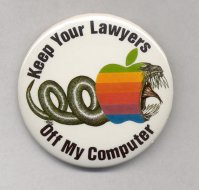
Apple eventually lost the lawsuit, but GNU did not lift the boycott on Apple until 1994. During this period, GNU kept accusing Apple. In the early 1990s and beyond, GNU began to develop GNU software projects that could be used on other personal computer platforms, including MS-DOS computers. GNU claimed that unless Apple stopped its monopoly ambitions in the computer field and allowed user interfaces to imitate some things of Macintosh, “we will not provide any support for Apple machines.” (Hence the irony that the UNIX-like system OS X developed by Apple in the late 1990s has a lot of software from GNU. But that’s another story.)
Torvalds and Jobs
Despite his more laissez-faire attitude towards most distributions, Linux kernel creator Linus Torvalds was much more amiable than Stallman and GNU’s past attitude towards Apple. In his 2001 book “Just For Fun: The Story of an Accidental Revolutionary”, Torvalds described a meeting with Steve Jobs, which was invited by the latter around 1997 to discuss Mac OS X, which Apple was developing at the time but had not yet been released publicly.
“Basically, Jobs started by trying to tell me that there were only two players on the desktop, Microsoft and Apple, and he thought the best thing I could do for Linux was to join Apple and try to get open source users to support Mac OS X,” Torvalds wrote.
The meeting obviously made Torvalds very unhappy. One point of the quarrel focused on Torvalds’ contempt for Mach technology. For the kernel that Apple was using to build the new OS X operating system, Torvalds called it “a piece of garbage. It contains all the design errors you can make, and even intends to only make up for a small part.”
But what was even more unpleasant was apparently Jobs’ way of invading open source when developing OS X (there are many open source programs in the core of OS X): “He kind of downplayed the structural flaws: who cares if the real low-core thing like the basic operating system is open source, if you have the Mac layer on top, which isn’t open source?”
All in all, Torvalds summarized that Jobs “didn’t argue much. He just spoke very simply, confidently thinking that I would be interested in cooperating with Apple”. “He knew nothing and couldn’t imagine that there would be someone who didn’t care about the growth of Mac’s market share. I think he was really surprised when I showed that I didn’t care how big the Mac market was, or how big the Microsoft market was.”
Of course, Torvalds didn’t tell all Linux users about this. His views on OS X and Apple have gradually softened since 2001. But in fact, as early as 2000, the leadership role of the Linux community showed deep disdain for Apple and the arrogance of its top management, which can be seen that some important things about the contradiction between the Apple world and the open source/free software world are deeply rooted.
From the above two historical anecdotes, we can see the major controversy about the value of Apple products, that is, whether the company is committed to improving the quality of the hardware and software it creates, or just making profits through market cleverness, making Apple products sell more money without creating functions equivalent to their value. But in any case, I will temporarily stay out of the discussion.
Reprinted with permission: Developer Relations »